
What Is Shoegaze? A Plain-English Guide to the Reverb-Heavy Indie Subgenre

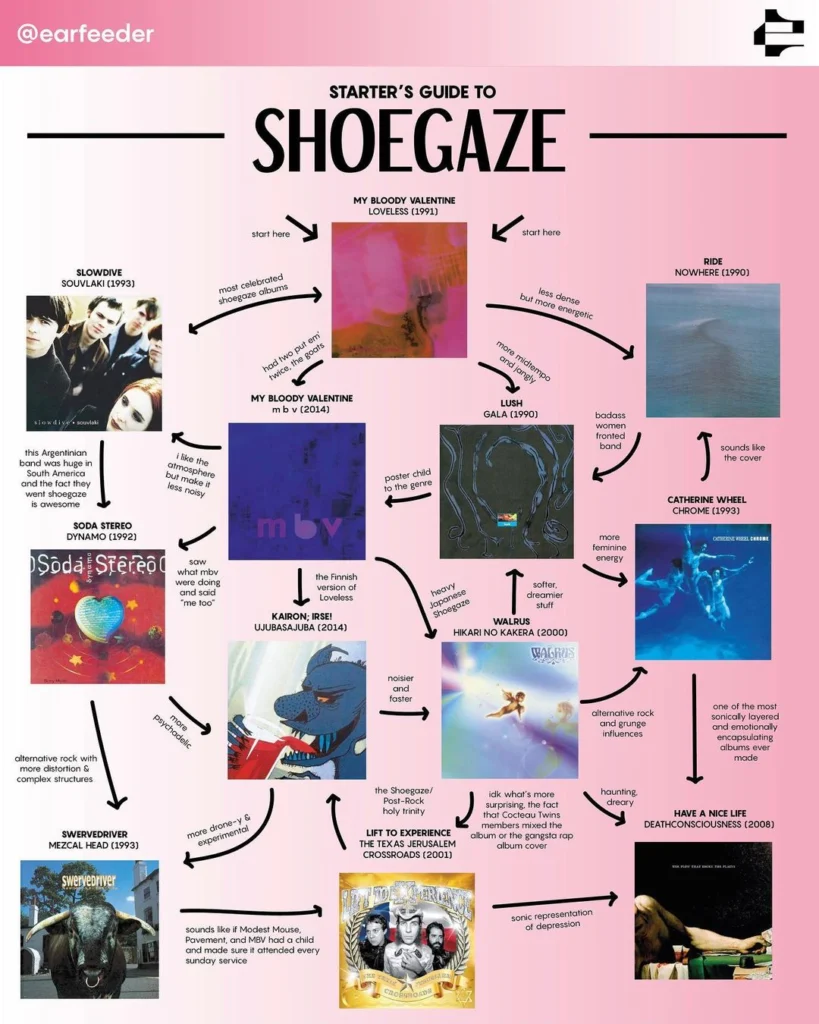
- The sound: how to recognize shoegaze
- Where it comes from: late-1980s Britain and the "shoegazing" label
- Shoegaze vs. dream pop, grunge, and post-rock
- Key records: five albums that define shoegaze
- Which bands are shoegaze? The yes/no list
- How to listen: a short shoegaze starter playlist
- FAQ: quick answers on shoegaze bands
Shoegaze is a subgenre of indie and alternative rock that emerged in the UK in the late 1980s. Its sound is built on heavily processed electric guitar—layers of reverb, delay, and fuzz—with vocals mixed low, like another instrument. My Bloody Valentine, Slowdive, and Ride are the usual reference points.
The sound: how to recognize shoegaze
Ask what is shoegaze music, and the simplest answer is a rock style built on processed guitar. The Merriam-Webster dictionary entry describes the style as rock music built on processed guitar and indistinct vocals. That is the core: guitars carry the song, and voices sit inside the mix rather than above it.
A typical shoegaze track stacks reverb, delay, and fuzz until the guitar stops sounding like a single instrument. Vocals are mixed low, often without a clear lead line. The melody comes from texture and chord movement as much as from a sung hook.
The glide guitar technique is a defining move. A guitarist holds a chord and works the tremolo arm while strumming, so the pitch bends slowly and blurs. MasterClass's shoegaze guide covers the technique as part of the genre's toolkit. Shoegaze sits inside indie music, but it pushes guitar processing further than most indie rock. On Loveless, the approach feels complete, while Slowdive's Souvlaki shows how much softer the same tools can sound.
Where it comes from: late-1980s Britain and the "shoegazing" label
Shoegaze came out of the United Kingdom in the late 1980s and early 1990s. According to Wikipedia's genre entry, the music is rooted in the Wall of Sound, the Velvet Underground, and 1960s psychedelic pop, and it developed mainly around acts influenced by Cocteau Twins, The Jesus and Mary Chain, and My Bloody Valentine. That line traces the sound back to post-punk as much as to indie rock. Shoegaze kept a melodic core even as the guitars got noisier, which is a thread you can follow in how post-punk's evolution into modern indie shaped its songwriting.
The genre's stylistic origins include indie rock, alternative rock, neo-psychedelia, noise pop, dream pop, post-punk, punk rock, garage rock, and space rock. That spread explains why shoegaze can sound very different from one record to the next. Its fusion styles include blackgaze and doomgaze.
The first wave centered on a small set of bands who shared a live habit: they stood almost still and looked down at their effects pedals. British music press picked up the term as a criticism. The word described a stage presence, not a sound, and the bands did not choose it themselves. The sound had been building for a few years before the label arrived; by the time the press used the word, the first records were already in stores.
Why is it called shoegaze?
The music press coined "shoegazing" as a pejorative. Guitarists looked down at their pedalboards instead of engaging the audience, and the label described that stage presence. Some writing used "shoegaze" and "dream pop" interchangeably at the time.
Shoegaze vs. dream pop, grunge, and post-rock
The boundaries between shoegaze and nearby styles are blurry. Shoegaze and dream pop overlapped enough in the early 1990s that some writers used the terms interchangeably, according to Wikipedia's entry. Today the two are usually treated as adjacent genres with different focal points.
| Style | Vocals | Guitar | Rhythm | Atmosphere |
|---|---|---|---|---|
| Shoegaze | Mixed low, indistinct | Reverb, delay, fuzz, glide guitar | Steady, often buried | Dense, immersive |
| Dream pop | Higher, melodic, often central | Cleaner, chorus and delay | Slower, soft | Airy, dreamy |
| Grunge | Raspy, up front | Direct distortion | Heavy, driving | Raw, tense |
| Post-rock | Often absent or spare | Clean to layered, dynamic builds | Variable, sometimes instrumental | Expansive, cinematic |
Dream pop usually keeps vocals higher in the mix, grunge puts them up front and strips the effects back, and post-rock often removes the voice entirely. Shoegaze sits between: the voice is present, but buried.
Key records: five albums that define shoegaze
The genre's core sound is concentrated in a handful of early-1990s albums. The five below are not the only shoegaze records, but they cover the style's best-known sounds. Together they became reference points for indie rock's influence on current music.
| Year | Artist | Album | Why it matters |
|---|---|---|---|
| 1991 | My Bloody Valentine | Loveless | The most fully realized use of glide guitar and layered noise; its dense guitar tones became a shorthand for the genre |
| 1993 | Slowdive | Souvlaki | Softer, vocal-led shoegaze with stronger pop melodies; a gentler entry point |
| 1990 | Ride | Nowhere | Brings chiming guitars and tighter songwriting, showing the genre's brighter register |
| 1992 | Lush | Spooky | Adds sharper hooks to the reverb-heavy template, with a faster, chorus-driven feel |
| 1992 | Catherine Wheel | Ferment | Shows how the sound could tilt toward heavier rock without losing its blurry textures |
Loveless became the benchmark for guitar noise; Souvlaki showed how quieter songwriting could work inside the style; Nowhere and Spooky kept hooks at the center; Ferment proved the sound could take on weight. Play one of these after a modern shoegaze release and the through line is usually obvious.
Which bands are shoegaze? The yes/no list
These verdicts are based on each band's core sound, not on influence alone. The big three are My Bloody Valentine, Slowdive, and Ride, but the first wave includes several other acts that fit the style.
Yes:
- My Bloody Valentine — yes; Loveless (1991) is the genre's reference album, and its guitar processing defines the sound.
- Slowdive — yes; Souvlaki (1993) is the clearest example of the softer side, with vocals placed just above the wash.
- Ride — yes; Nowhere (1990) sits at the brighter, more pop end of the first wave.
- Lush — yes; Spooky (1992) fits the genre's core, with choruses that cut through the reverb.
- Catherine Wheel — yes; Ferment (1992) is shoegaze with a hard-rock edge and longer, heavier builds.
- Chapterhouse — yes; part of the first wave, though less known than the big three today.
No or not strictly:
- Radiohead — no; they use effects heavily, but their core is alternative rock, not shoegaze. A few songs borrow texture without making the whole catalog belong to the genre.
- Deftones — not strictly; they mix shoegaze texture into alternative metal, especially in quieter passages, but the band's heaviness keeps them outside the genre.
- Smashing Pumpkins — no; layered guitars overlap, but the songwriting and vocal placement sit closer to alternative rock with grunge and prog elements.
Influence is not the same as membership; a band can borrow a reverb-heavy guitar part without becoming shoegaze.
How to listen: a short shoegaze starter playlist
Five songs show the style's range, from noise-heavy to melodic. Play them in order and listen for the shift in guitar texture and vocal placement.
- "Only Shallow" by My Bloody Valentine (1991) — opens Loveless with walls of guitar.
- "Alison" by Slowdive (1993) — a softer, vocal-led example from Souvlaki.
- "Vapour Trail" by Ride (1990) — bright guitar lines over a steady rhythm.
- "Sweetness and Light" by Lush (1990) — faster and more pop-leaning than the slower side of the genre.
- "Black Metallic" by Catherine Wheel (1991) — long and slow-building, with distorted texture.
FAQ: quick answers on shoegaze bands
Who are the big 3 of shoegaze?
My Bloody Valentine, Slowdive, and Ride, with Loveless, Souvlaki, and Nowhere as reference albums.
Is Radiohead a shoegaze?
No; Radiohead is alternative rock with effects, but their core sound is not shoegaze.
Is the Deftones shoegaze?
Not strictly; Deftones mix shoegaze texture into alternative metal, but they are not a shoegaze band.
Is the Smashing Pumpkins shoegaze?
No; they share layered guitars, but are alternative rock with grunge and prog elements.
Keep reading